January, 2014
China
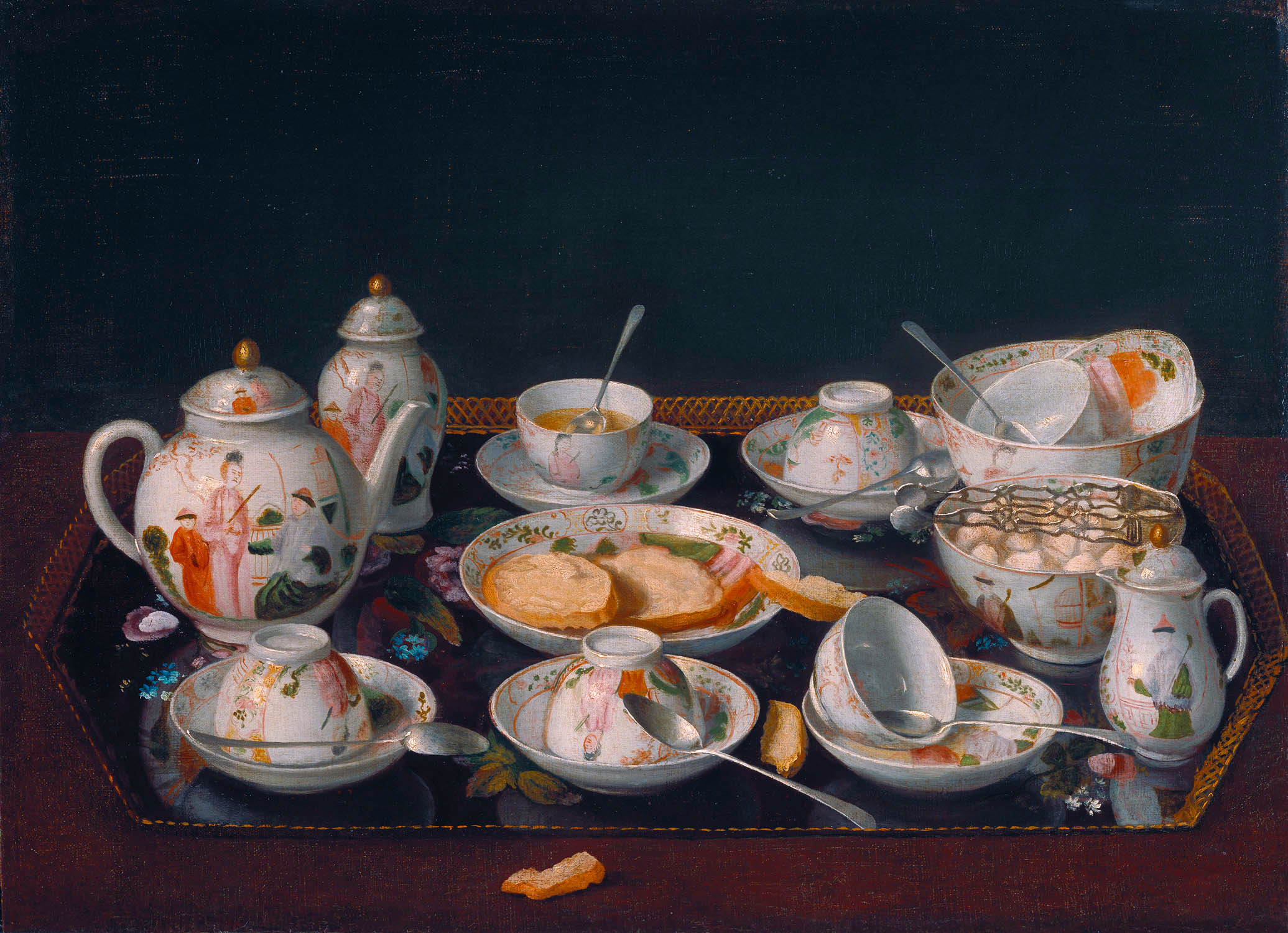
This story begins the way most things begin, which is to say that this story begins in a rather dull way: a milkmaid is getting ready to take her tea. She is a very poor milkmaid, and her cottage is bare as an egg. It has a three-legged iron stove in one corner, and a rug that’s gone threadbare and grey in the spot where the milkmaid stands to churn the butter. There are cobwebs in some places, and dust in others, and in one corner there is a photograph of two smiling people who are perhaps the milkmaid’s parents, but they are dead now. The only thing of any interest in the cottage is a set of china tea-things, sitting atop the sideboard like a veritable shrine.
It is a splendid tea-set, though upon closer inspection one can see that the china is a lacework of cracks, and very old. There are two dainty cups with tiny orange flowers painted around the edges, a creamer and a sugar-bowl with a pair of pewter tongs to fish out the lumps. There is the loveliest, loveliest teapot you can possibly imagine. And on the bottom of three of the pieces are symbols, sharp black lines and crosses, a language the milkmaid has never been able to read.
The milkmaid drinks tea from her tea-set exactly once per week, and she takes great care to make the occasion special. She sweeps the floor with a twig broom, opens all the windows to exchange the air, boils the water, measures out the precious leaves, arranges her tea-things precisely, sits down at her table. . . .
*
Should you have come by the milkmaid’s dwelling just then and peered through her bottle-glass window, the scene that would meet your eyes would most likely strike you as ridiculous—a stout milkmaid, no longer quite young, alone at a wobbly table, trying to be prim, simpering with the sugar bowl, buttering slips of bread and nibbling at them prettily. You would think her silly.
But the milkmaid does not know that you are watching, and so she doesn’t mind. She is very happy when she drinks from her tea-set. It was her inheritance from the smiling people in the photograph, and when she uses it, when she even looks at it, she feels she is a child again. She feels her parents are right there with her, and she feels they will always be her parents as long as she has the tea-set. It is her favorite thing in the whole world.
Until one day. Until today.
*
For just in the moment when the milkmaid is lifting the teacup to her lips, the teacup moves. Only a little bit. Only one tiny, tiny shiver, like a bird about to hatch. But it moves.
The milkmaid looks at it quizzically. Then she raises her eyebrows and brings the cup back to her lips. The cup shivers again, this time so severely that flecks of tea spatter the milkmaid’s nose. The milkmaid, in an attempt to calm the teacup, lays it back hastily on its saucer. But it does not stop. It continues to shiver, rattling and spilling tea over the rim, harder and harder, and now suddenly there is a voice, cold and pure as porcelain, saying: “Break it. Break it. Split its back and shatter its bones.”
The milkmaid jerks away in terror, but the teacup continues to speak, hollow and dark, louder and louder. And then the milkmaid picks up the cup in a fright and throws it down with all her might against the tabletop. The teacup explodes into a dozen small white pieces . . . And what should come out of it but a very long, skinny creature, brown and red and green, and flat as paper. It might be a dragon, but it is very furry, and it has horns. It turns a circle on the tabletop, joints clicking, looking rather stiff, and then, noticing the milkmaid’s wide-eyed stare, squints up at her and says in a silky, hissing voice:
One wish now
Quick and careful
Then have your tea
And be quite cheerful.
The milkmaid screams and hits the creature with a heavy fist, and its legs squeeze out on either side. But then it turns to smoke and blows out from under her fingers, and comes to rest on the corner of the table.
“Come now, quickly, what would you like?” it says, in a slightly less sinister voice. The milkmaid screams again.
The creature peers at the milkmaid askance. “I do not understand your wish,” it says.
The milkmaid lets out one last strangled cry and then puts her head between her knees, trying to calm herself. She has heard tales like this one. Be careful what you wish for. Be careful, be careful. She raises her head. The creature is still there. She watches it carefully, and it watches her back.
“Shouldn’t you give me three?” the milkmaid squeaks. “Three wishes?”
“One wish!” says the creature imperiously. “And you can’t wish for more wishes, now hurry.”
The milkmaid thinks and thinks, so long that the creature wonders if perhaps it got a bad apple and it will have to wait all night. The milkmaid thinks of the tales she has heard, and she tries to makes sure her wishes will not backfire too badly, and then she says: “I would like a great lovely house, furnished and weather-tight, right here where this house is.”
And the next instant the cottage is gone and it is replaced by the strangest, most marvelous building the milkmaid has ever seen. The walls are lacquered wood, and the floors are strewn with pillows, and the windows are large and wide. The rooms are a bit too colorful for the milkmaid’s tastes, and she is not enamored with the artwork, but it is too late to change anything, because the creature has dissolved into a purple plume that is making its way up the chimney.
*
The milkmaid is so pleased with her new house. She wanders through it and admires the many rooms and the many windows and fire-pits. She finds the remaining pieces of her tea things sitting on a low, glimmering table, and her heart hurts for a moment, for the broken teacup, but then she thinks the china looks even more lovely now, like it belongs here. She thinks she will be very happy now.
But the next day, a tax-collector, coming along the road down from the town, sees the great mansion and he comes up the path and knocks at the door, wondering where this wonderful new house has come from and whether it has been properly taxed. Of course, it hasn’t. The milkmaid is very afraid when she opens the door. She tells the tax-collector that the house is only just built, and she will be paying the taxes the very next day, and then she closes the door quickly and locks it, and hurries through the house wringing her hands and wondering what to do. She doesn’t want to sell the house, or anything in it, and she doesn’t have time to, really. She comes to stand in front of the magnificent tea-set, sitting on its table. She stares at it. And now she is taking another teacup, and her heart is pounding so dreadfully. She is lifting it and smashing it on the floor. She winces as it breaks. Please, she thinks. Please be another strange, small creature.
And indeed out slips another one, this one like a spider, emerald-green, with long and spiny legs. It says:
In such a house
All red and gold,
What could there still be
You wish to hold?
And the milkmaid says, “Quickly, please, I must pay all the taxes on my house and I haven’t any money! Give me all the money I will ever need.”
The next instant the house is full to bursting with gold and jewels. There is enough to pay all the taxes for the rest of the milkmaid’s life, and she nearly dies of relief.
*
It is not long after the tax-collector had come and gone, that people begin to notice the beautiful house with its many gables and colored walls, and begin to think the milkmaid far more interesting than they had before. They come from far and wide to knock on the milkmaid’s door and speak with her, and she revels in the attention. No one ever visited her before. No one spoke to her, except to tell her the cows were in the wrong field, or the milk was late. Now they compliment her lovely house and the gape over all her gold and jewels. But as time passes, the milkmaid notices that while they talk to her a great deal they never really say anything. It is so strange; the milkmaid is sure she had had better conversations with the tea-set in her lonely cottage than with these people, who paw over her furniture and drink great quantities of her tea.
The milkmaid doesn’t know why this is. She wonders long and hard, and she decides it is because she is still a great clumsy milkmaid, and though she is kind and unassuming, she feels she is not as fine as all the wonderful people who visit her. Perhaps, she thinks, if she were like them, they would be her friends. They would tell her secrets and invite her to their own homes, and not just come to hers. And so, without another thought, she goes to her tea-things and takes up the sugar bowl and smashes it on the floor, and out comes another odd creature, this one like a black worm, all glistening and wet.
A third wish then?
Again, again?
You want a lot,
You silly hen.
The milkmaid says, “I would like to be someone else. Someone beautiful. Someone more beautiful than anyone in the entire country, in the entire world!”
And the next instant she is just that, and the worm has split into a thousand smaller worms that wriggle and creep into the floorboards.
The milkmaid goes to the mirror. She can hardly breathe when she sees herself. She has glimmering crow-black hair, and her face is so beautiful it is like the sun and the moon and all the stars put together, and her old, work hardened hands have become long and fine as any china.
*
But when the milkmaid again receives visitors to her mansion on the hill, they are somewhat quieter around her, somewhat more cautious, and then one of them asks her what has become of the silly, ugly milkmaid who had lived here before. It breaks the milkmaid’s heart to hear them. She sends them all away. She stops letting anyone in when they knock. She becomes lonely, lonelier than she ever had been before, and though she tries to sweep her great house and lay out the tea-things and feel happy again, she has only the teapot now and the creamer, and it feels desolate somehow, and not the same.
At last, she is so unhappy that she goes to her teapot and clutches it to her. She does not want to break it. But then she thinks of the picture in the frame that had vanished with her old cottage, of the smiling faces, and she thinks of drinking tea and buttering scones in the quiet of her shabby home, with only her own thoughts and memories, and all her tea-things gathered around her, and suddenly she knows what she wants, she knows exactly.
She lifts the china teapot to her chest, after a long, fond gaze, lets it slip from her hands. There is a great crashing. The china blooms across the floor like a sharp flower. . . . But there is nothing inside the walls of the teapot. No dragon or spider or worm, and nothing to grant the milkmaid’s last, most desperate wish.
*
Now, if you came upon the milkmaid’s mansion and pressed your face to a crystalline window, and glimpsed through the gap in the velvet curtains, the scene you would meet your eyes would be very different from before: a beautiful room, and a beautiful woman kneeling in the midst of it, crying her eyes out, and spread all around her the remains of a lovely china tea-set, smashed all to bits. And perhaps you would wonder what such a beautiful woman could have to cry about, and you would see her gold and jewels and think she really has no reason to cry; she could simply buy a new tea-set. And you would go on your way, and think how foolish are the rich and vain. But the milkmaid would not know your thoughts, and she would weep and weep and weep. . . .
*
So as you see, this story ends differently than most things end, which is with a sunset, or a wedding, or a bloodied axe. But it is an ending, and the milkmaid has come to realize something very cruel about the world: that you can have a great many things from life, but not for nothing, and perhaps the things you gave away are what you wanted most.
Harvest Day
“Peter? Are you awake?”
“What do you think?”
“Sorry, jeez. Just . . . I can’t sleep.”
“No kidding?”
“I just wanted to talk. Okay? I’m about to go crazy over here.”
“Yeah, well, I don’t feel like talking.”
“Why are you being such a jerk? Peter? Pete, answer me. Are you still there? They haven’t—”
“No. I’m still here. And don’t cry, Adam. Just . . . don’t cry, okay? I can’t take it.”
“So?”
“So I’m just freaked out, all right? And I don’t want to talk about it.”
“Do you think They’ll take me?”
“You’ve asked me this a million times.”
“And?”
“My answer’s the same: I don’t know. No one ever knows who They’re going to take.”
“. . . Peter?”
“Yeah.”
“Are you scared?”
“You’ve asked me this before.”
“I know. I’m running out of thoughts. They’re all turning panicky.”
“Yeah. I don’t know. I’m scared, yeah. But at the same time, I’m so used to being scared about this night that I’m kind of past being scared. I mean, it happens every year, and there’s nothing I can do about it, so why waste time being scared about it? Does that make sense?”
“No. Kind of, I guess.”
“Yeah. Well, that’s how I feel. Until I figure out a way to get out of here, I’m stuck with this night, and I’m stuck with being scared.”
“Peter?”
“Yeah.”
“Do you think our parents knew about what goes on in this place when they moved here?”
“I don’t know. I don’t think so.”
“. . . Do you think they’d still have moved here if they did know?”
“What kind of question is that? God!”
“Well, it’s just that . . . it’s so beautiful here. You know? And my dad’s always wanted to live someplace beautiful. Maybe he thought it was worth the risk? I just wonder.”
“Let me tell you something: It isn’t worth it to wonder. You’ll drive yourself crazy. Have you heard the story about that kid Rory?”
“No.”
“Rory lived over on 10th Street. He was so paranoid when it came to his mom. Like, he thought she was in on the whole thing. That she’d made a deal with Them. Because he and his mom didn’t get along so well. You know? So he started to think she’d moved them out here so she could get rid of him, nice and clean, without anyone knowing, without her ever getting caught.”
“But, I mean . . . he was wrong, right?”
“Who knows? He tried to kill his mom one day. Tried to push her down the stairs. He just knew, you know? He knew she was in on it. He knew she was just waiting on the day They would come and take him.”
“God.”
“I know.”
“Well, so what happened to him?”
“He vanished after that. His mom was fine, though. She’s that old lady now, who lives on 10th.”
“Ms. Rowengartner?”
“Yep.”
“But she’s so . . . sweet.”
“Yeah. They all are, aren’t they? Until they’re not.”
*
“Peter! Pete, wake up.”
“Huh? What? Adam?”
“Listen—”
“I can’t believe I fell asleep.”
“Shut up! Just shut up and listen.”
“To what?”
“Outside.”
“Is that . . . ?”
“I think it’s next door.”
“Moira. Oh no. Don’t listen to it.”
“I can hear . . . what is that? Oh God, it’s Them.”
“I said, don’t listen! Plug your ears. Listening to Them is one of the ways They find you.”
“But Moira—”
“What are you gonna do? Save her? It’s too late.”
“Peter, I’m freaking out—”
“I’m right here.”
“They sound like—like animals . . .”
“It’s okay. Plug your ears. Just breathe. Breathe, and don’t listen, and They won’t be able to find you.”
“How do you know?”
“I’ve lived here all my life, and They haven’t taken me yet. So there’s that.”
*
“Peter?”
“Yeah.”
“Do you think it hurts? When They take you?”
“I don’t know. Probably.”
“I’ve heard people say that when they get inside you, it feels like your skin’s going to split open. I’ve heard stories about people taken by Them who go nuts before they’ve even been dragged out of their house. They go nuts and tear their own skin off because it hurts that bad.”
“I wouldn’t listen to stories, Adam. People will say anything.”
“You mean stories like the one you told me about Rory?”
“Yeah, well, some stories are true. You just have to know who to trust.”
“Who am I supposed to trust, Peter? Who am I supposed to trust when I can’t even trust my own parents?”
“You can trust me. I’m your friend.”
“For now.”
“What the heck, man? What do you mean by that?”
“I mean, what if it came down to a choice between saving me from Them and saving yourself? What would you do?”
“I don’t want to talk about this anymore.”
“Yeah. That’s what I thought.”
“I hope it was quick, for Moira.”
“You’re changing the subject.”
“Yeah, well, you’re being an idiot. I hate hypothetical questions.”
“. . . Do you think that was it, then? Are we safe now? Do you think what we heard was Them taking Moira?”
“Or was it a trick? Is that what you’re getting at?”
“A trick, or maybe Them just having fun. Not taking her, but just . . . messing with her.”
“I don’t know. You never know until the next day, at dawn, when you wake up and realize you’re still safe and in bed. That’s the only way you know for sure that you made it. That They didn’t take you this time.”
“Peter?”
“Yeah.”
“Is that the sun coming up, over there, do you think?”
“Could be.”
“Or maybe it could be Them burning someone’s house down, like last year. Flushing them outside.”
“Maybe. You never know.”
“Yeah. You’re right. You never know until dawn.”
*
“Peter? Crap! I fell asleep again.”
“Peter? Why is it so cold in here?”
“Peter. Peter, why did you open the window?”
“Peter. Come on, stop trying to scare me. Say something.”
“Peter, you know I’m not going to get out of my bed. My feet aren’t going to touch the freaking floor, not until sunrise.”
“Peter, I’m going to throw this shoe at you. I’m sorry if it hurts, okay? Don’t yell at me for it. I just . . . I have to know. And I’m not getting out of this bed.”
“Peter. God . . . Peter.”
“You’re not there. Are you? Pete?”
“You’re not there. Oh my God, Peter. I’m so sorry. I’m sorry I fell asleep!”
“They . . . I don’t believe it. I mean, I know I was asleep, but . . . They must have come in so quietly. I would’ve woken up.”
“Unless you went out on your own. Did you?”
“You wouldn’t be that stupid, would you, Peter? You wouldn’t try something stupid and heroic?”
“I would’ve woken up, if you’d yelled for me. I would’ve woken up. I would’ve helped you.”
“Peter. I’m so sorry.”
“I’m so, so sorry.”
A Birthday Song
I wake up with that excited, awesome birthday feeling. Yeah yeah YEAH: it’s my birthday.
I wake up already dressed, actually, in my best and favorite clothes, lying on top of a made-up bed — I was so excited last night, I just wanted to be READY.
For my BIRTHDAY.
Everyone’s playing it pretty cool at breakfast. I grab a bowl of cereal and sit down next to Luke, and he doesn’t even look up from his Minecraft game. Thanks, bro!
Mom’s on the phone talking like mad. I try to catch her eye, get some happy birthday, honey! going, but she walks out the door still talking, holding her other ear closed, even though we aren’t EVEN talking. Dad’s already left for work. Luke’s still on Minecraft. Oooookay.
Then from the front door, Mom’s yelling, “Into the car, let’s GO, leave the dishes. Game turned OFF and left on the table, please!” I jump in the car behind Luke and we’re off.
And I’m feeling a little weird, because, hello, did everyone forget it’s my birthday? But just then, like she’s reading my mind from the front seat, Mom says “Hey, kiddo. Big day today. I haven’t forgotten. Don’t you worry about that, buddy. Me forgetting why today is special, that will never, ever happen. We’ll celebrate tonight, OK?”
“OK!” I say, feeling Yes, yes, yes. “I knew you remembered, anyway. I knew you wouldn’t forget.” I smile hugely at her eyes in the rearview mirror. But she’s all eyes on the road, as usual.
Luke just kind of slides down in his seat, staring out the window. Doesn’t look too happy. Um, jealous much? Your birthday’s next month, today is mine-all-mine.
School! Which I slightly hate but it has its good points, and one of them is home room, which is also music class, which I love. I sit at the table in my place by Brandon. As usual he doesn’t even look up from his thing he’s drawing, maybe it’s a dinosaur this time, or I can’t even tell.
Ms. Revis is my favorite teacher. She has short black hair and giant brown eyes like a manga drawing, and she’s super cheerful. “We’re singing today,” she says. “We’re going to apply some of those principles of harmony we’ve been learning.”
I do not remember a single thing about harmonies—guess I need to pay more attention in this class. We’re singing some extremely ancient folk song called “Sweet William’s Ghost,” about a dead guy who comes back to bother some lady he was supposed to marry or something. This was supposed to be their wedding, or their anniversary, or some big-deal date like that. Anyway, so he shows up, a ghost, and then she wants to get into the coffin with him or something. It’s pretty weird.
Is there room at your head, Willie,
Or room here at your feet?
Or room here at your side, Willie,
Wherein that I may sleep?
The class is singing it with these pretty harmonies, that sort of weave together in and out. I stand right behind Dylan and sing along with what he’s doing, because he’s pretty good. Twice he looks back though and gives me the weirdest look, like I am making him nervous. Everyone is in a VERY weird mood today.
There’s no room at my head, Margaret
There’s no room at my feet
There’s no room at my side Margaret
My coffin is so neat.
Kaylee, I’ve known her since kindergarten and she cannot sing AT all, is playing the recorder. It actually sounds really pretty, this sort of sad whistling sound, like wind in bare trees, under the singing.
The whole thing is really pretty beautiful.
And it makes me sad, for some reason.
But no good being sad on your BIRTHDAY. I shake it off. I’m fine in math. I try to make Jessica crack up in biology, but she keeps a straight face.
Before lunch I think: maybe this is it—maybe Mom and Dad sent a surprise cake. Or maybe one of them will come themselves, holding a gigantic cake with a zillion candles, and the whole cafeteria will sing for me.
But: nope. Most exciting thing that happens is the cafeteria lady lets me slide through without paying, which if that’s the best birthday present I get, I’m going to be pretty depressed. I sit by myself, making lots of room for someone to come talk, but, whatever. No one does.
At home after school, it’s also weirdly quiet. No big hanging HAPPY BIRTHDAY sign or even a balloon. I guess maybe they figure I’m getting too old for that? Which kind of sucks, actually.
And I don’t get why everyone is so sad and quiet at dinner. Dad makes one of his dopey jokes, and it’s pretty funny, so I laugh. No one else does, not even Dad.
But then finally — finally—it happens. We clear our plates, and Dad turns down the lights, and Mom brings out a cake, a German chocolate cake, my favorite kind. And the candles are lit, and she sets it down in front of me, and I feel so happy. I feel so happy that I don’t even care about presents any more, I’m just so glad someone remembered. I’m just so glad my birthday finally came.
Happy birthday to you, my mom sings, really soft. Dad and Luke don’t sing, which is weird. Happy birthday to you. Her voice is soft and shaking, and tears are coming out of her eyes, why? Happy birthday my darling, happy birthday to you.
“We miss you, baby,” she says, in the quiet after. She blows her nose in a napkin. “We miss you so much, we miss you every day, and we love you forever and ever and ever.”
She sits down, crying really hard now. Luke is crying, Dad is crying, everyone is crying. I stand up so suddenly I knock my chair over, and they all shout and jump up.
“What the hell,” says my dad.
“But I’m right here,” I say. I guess I’m crying too. “I’m right here, look at me, you don’t have to miss me, I’m right here.” They are staring at the stupid chair on the floor, holding each other, like they don’t see me, like I’m not even here.
And then, all of a sudden, I know. All of a sudden, I see.
I run into my bedroom and throw myself on the bed.
I remember my Mom in the car. Hey, kiddo. Big day today. I haven’t forgotten, don’t you worry about that, buddy. She wasn’t talking to me, oh now I see.
She was talking to Luke.
And now I know why Luke looked so sad in the car.
Now I know why Dylan kept looking over his shoulder when I sang.
Now I know why I woke up wearing my best clothes, my favorite clothes today.
It’s because they buried me in these clothes. Of course they did, I remember now, somehow I forgot, how could I forget?
I died. I died six months ago.
I forgot, the way you forget a bad dream. And then suddenly, it all comes back to you.
I lay back down on my made-up bed, in my favorite clothes. But it isn’t my bed anymore, in my own nice house, with my pale blue walls.
It’s my coffin I’m lying in, now.
It’s my coffin I’ll always lie in, now.
In my coffin, in the dark, on my birthday, all alone, I start to sing. I sing really softly, the saddest birthday song.
There’s no room at my head, Margaret
There’s no room at my feet
There’s no more birthdays for me any more
My coffin is so neat.
I hope I can fall asleep.
I hope when I wake up, it’s my birthday.
Birthday Wishes
Bright red candle wax had melted and hardened into pools on the white birthday cake.
It looked a bit like blood, honestly. And the icing, it looked a little like snow, but outside, there was no snow. It was gray and miserable, and if there had been any blood, the ceaseless rain would have washed it away.
Outside.
And inside, well, there are different ways to bleed.
The birthday cake sat on a dining table laden with pretty china and heavy, ornate silverware. The china was littered with sandwich crumbs, the knives and forks smeared with butter and jam. Napkins crumpled like fallen roses beside each setting.
It had been such a lovely party.
#
“Where am I?” asked Agnes Agnew, who hated her name and her shoes and had hated her birthday party, which was why she’d made that wish. It had all been so boring, and her mother’s sandwiches had been dry and they’d still had the crusts on. Both her parents forced her to give pretty little scallop-edged invitations to all the silly girls at school, absolutely none of whom liked Agnes.
She had no idea why. And it didn’t matter. She didn’t like any of them, either. So there.
Here, all around her, was a sort of thick white mist. Somewhere in the depths of it, something went thump.
Agnes looked around, but she couldn’t see a thing. “Hello? I asked where I am, and it’s polite to answer.”
Something went thump again.
Two somethings.
Agnes’s first impression was of…stars. No, that couldn’t be right, but the woman’s dress glittered like a thousand of them, twinkling ice-blue, catching little pinpoints of light, though there were still no lights here that Agnes could see. The woman stomped out of the white mist, dark hair in tangled disarray, pale skin flushed at the cheekbones.
“My, my,” said the woman. “Impatient little thing, aren’t you? I’m coming. Four hundred and twenty-three birthdays I’ve done today, and it’s no lark, I can tell you. Where do you children even think up these things to wish for? Do you know how difficult it is to snap my fingers and create a perfectly crisp toffee apple after November the first? There are laws, I can’t just go running around bending all of them. And everyone expects me to do it all in these ridiculous heels, even though no one ever sees me. Because that makes complete sense, of course.”
“Who are you?” asked Agnes, momentarily distracted from the bigger question of where, in fact, she was.
“Your birthday wishes don’t grant themselves when you blow out those candles, you know.
“So you’re, like, a birthday fairy? And what kind of idiot wishes for a toffee apple when they blow out their candles? I hope it made them sick.”
The woman’s eyes narrowed. “A poor little boy who’s never had one, I expect. You must be Agnes.”
“Yes. And for the last time, I want to know where I am. What is this place?”
“It is…a place,” said the woman. “I suppose you could say it is my home.”
“Love what you’ve done with it.” Agnes sneered, glancing around again into the vast swathe of fog.
The woman-fairy’s hand twitched. The mist cleared.
And Agnes gasped.
The high, stone walls of a magnificent castle rose around them. It had turrets and everything. Below Agnes’s party shoes and all over the courtyard, green grass grew. A huge tree grew in one corner. In another, a table not unlike the one in Agnes’s home was set for a party.
Including a large, white cake with red candles.
“You have a very interesting mind, you know.” The sparkles on the dress shone a hundred times brighter in the sunlight that now poured down. “It’s really very rare that someone can do what you did—wish for two things at precisely the same moment. You wanted everyone to go away and you wanted to be somewhere else. Unusual. And most children do enjoy their birthday parties. Just a friendly tip, there, for next year.”
“It was horrible. And Jessica tried to pin the tail on me instead of the donkey.”
“Astonishing.”
Agnes sensed she was being insulted, but for perhaps the first time in her life, she chose not to say anything. There were too many other important questions, and she wanted to run off, to explore the castle, if she could just slip away…
“Don’t even consider it,” said the woman. Fairy. Whatever she was. “When someone like you comes along, thankfully rarely, I bring them here for a wee little talking-to. A chat, you might say. Come, sit down.”
Agnes felt her feet being pulled along, as if by an invisible hand, toward the pretty table. The woman waved her hand again and two chairs slid out. Agnes tried to take the one at the head, but it shifted at the very last minute, and only by grabbing the table did she manage to stop herself from falling right over.
The woman pointed at the other one. Agnes sat. A teapot raised itself into the air and poured its contents into two mugs.
“Milk? Sugar?”
Agnes shook her head.
“Right then. I work very hard,” said the woman, dabbing at her eyes with a napkin and then crumpling it like a fallen rose beside her plate. “So did the one before me, and the one before her. It’s not easy, running around and granting wishes all the time.”
“That’s really what you do?” asked Agnes.
“Oh, yes. Parents are lovely, you see. And grandparents, friends, aunts and uncles. Throw the child a wonderful party, most of the time. But some wishes…some wishes are just for us.”
Agnes thought of that morning, when she had pulled on her dress and tights and shiny, buckled shoes, never telling her mother and father that she didn’t want the party to begin with. She would have been happy with just the presents.
“And of the wishes that are just for us,” the woman continued, “some are easy, and some are…not. But we grant them all, no matter what.”
“So?”
The woman’s eyes narrowed again. “So, young lady, I brought you here to tell you there are a great many worse off than you, and some, like me, who work harder. Stop being such an ungrateful little brat. I spent an hour on you alone today, not just bringing you here, but sending all the others home, where they’ll have memories of a lovely afternoon, nothing out of the ordinary. Your parents are having a nice nap.”
“You can do that?”
“Not the point!” snapped the woman. “The point… The point is that I’m a generous sort, because I have to be. So you get another chance. I’m going to light the candles on that cake, there, and you’re going to make a nice wish. A good, proper wish, befitting a good little girl. I don’t even care if you don’t mean it. You’ll do it, and then we’ll all get on with our day, shall we?”
Agnes considered this. Deep down, in the darkest corners of her heart, she knew she’d been just a little bit awful to her parents, and Jessica had only tried to pin the tail on her because Agnes had pinched her first. And at school…she didn’t exactly speak to any of them, ever.
She put on a big, bright smile. “All right,” she said.
The candles flared to life. Agnes took a deep breath.
#
Agnes’s second first impression was of stars. They flared all around her as she twirled in the dress. The high heeled shoes did thump when she stepped.
Her wish echoed in her head. I wish to be you.
She thought of the little boy who had wanted a toffee apple.
Oh, this was going to be marvelous fun.
January: And The Year Comes ‘Round Again
It was a year ago this very week–said the wrinkled hag, pulling her threadbare cloak closer against the freezing wind, and somehow simultaneously pointing a crooked cane at you in warning–
–(figuratively, of course: in reality, I am wearing a rather chic wool raspberry-colored coat, and pointing at you with one long, elegant finger and shiny, plum-painted nail)–
–anyway: it was a year ago THIS VERY WEEK that we four Cabinet curators first began to share our delicious and horrifying story collections on this website.
Much has happened in that year: we have fought with bad luck, poison flowers, lizard people, rightly furious whales–oh, the list goes on. Why in the past year, nigh-on to fifty terrifying tales have scrolled down and down these death-blue pages! cried the wrinkled hag, etc etc.
This year we have also begun preparations for a book of our adventures, including a number of new tales too dreadful to have been included here in public. That book will assume physical form in your trembling hands on May 27 of this year.
In honor of this anniversary, and that significant day, this month our stories will focus on calendars, and anniversaries, and other important dates.
So happy anniversary to us. Put on your party hats, boys and girls.
But be very, very, careful when, quite suddenly, all of the lights go out.