Author Archive
Red Shoes and Doll Parts
The story of Jackie and Mr. Jimmy is similar to that of the chicken and the egg.
Which came first?
Did Jackie start talking to Mr. Jimmy so much because the kids at school made fun of her and called her Wacky Jackie? Or did the kids at school start making fun of Jackie because all she ever did was talk to Mr. Jimmy?
No one really knows; not even Jackie knew.
But she thought she did.
She would get home from school and take Mr. Jimmy out of her backpack and sniffle over his cold, wooden head.
“Oh Mr. Jimmy,” she would say, crying into the mirror, which made things all the more awful, because she hated her uncontrollable hair and her pimples and how she looked like a string bean boy in her clothes, “why do they have to be so mean to me?”
And Mr. Jimmy would say something soothing like, “You shouldn’t care so much about what they think, Jackie. Jackie, they’re scum. Jackie, they’re little creeps. I hate them so much. Don’t you hate them?”
But Jackie would shake her head. “No. Hating’s bad. Mom and Dad say so. You shouldn’t hate people, Mr. Jimmy. Please don’t.” And then she’d put Mr. Jimmy away. He frightened her when he said things like that.
One day, though, it was the first warm day of spring, and Jackie had worn the prettiest sundress to school. It had polka dots and ruffled cap sleeves and a bright red belt. She had felt like an absolute princess, like a flower full of petals. But instead of everyone at school being impressed by Jackie’s style, they had poked fun at her—for dressing up too much, for dressing too old-fashioned, for being able to see through her skirt, for trying to be so pretty when she obviously was so not.
Jackie ran all the way home from school, and tore up her matching red shoes.
Her parents weren’t home yet, and she was glad. No one should have to see her like this. No one but Mr. Jimmy. She hugged him tight and cried over his crisp little blue suit.
“Oh Mr. Jimmy,” she said at last, when she stopped crying enough to speak. Her voice was full of hiccups. “I do hate them. I do hate them.”
Mr. Jimmy was quiet for a very long time. Then he said, “Oh? Is that really true?”
Jackie nodded fiercely. “I hate every single one of them.”
“Then we should do something about it. Don’t you think?”
Jackie wiped her eyes and stared. “What do you mean? What could we do?”
“Oh.” And Mr. Jimmy, even though it shouldn’t have been possible, seemed to smile. Not his painted-on smile, but one from deep inside himself. “I have lots of ideas. I’ve had lots of ideas for a very long time.”
“What kind of ideas?”
“We could get back at them.”
“But how?”
 “Trust me, Jackie. Trust me. I have your best interests at heart. I love you, Jackie.”
And poor Jackie, her face all red, smiled. “I love you too, Mr. Jimmy. You’re the best friend I have in the whole world.”
“And I have been for a very long time.”
“Why, yes.”
“And I always will be. Your very best friend.”
Jackie laughed. “Of course! Don’t be silly.”
“This isn’t silly to me, Jackie.”
There was that tone of voice that sometimes scared Jackie, the tone of voice Mr. Jimmy had when he talked about hating people. But Jackie was too tired from crying to care very much. So she put Mr. Jimmy on his stool and crawled into bed for a nap. It was exhausting to cry so much. She didn’t even stop to take off her ruined red shoes. She nestled into her pillows and stared across the room at Mr. Jimmy’s face until she fell asleep.
And Mr. Jimmy sat on his stool and stared back, which is the only thing ventriloquist dummies are supposed to be able to do.
But Mr. Jimmy was special. Jackie would have been the first to tell you that.
The next day, Jackie’s parents heard a slight wooden clatter at the kitchen table, and looked up from their cereal to see Jackie settling Mr. Jimmy onto her old booster seat, from when she was too little to reach the table on her own.
“Jackie,” said Jackie’s mom, “why is your doll at the kitchen table?”
Jackie’s dad frowned and fiddled with his glasses. “Aren’t you a little old for such things?”
“Don’t listen to them, Jackie,” Mr. Jimmy said through his bright white wooden teeth. “Things will be different from now on. People might not understand us, Jackie. They might not understand how much we love each other. But you and I understand, and that’s enough. That’s enough.”
Jackie worked very hard to pretend like Mr. Jimmy hadn’t said anything at all. She had figured out a long time ago that no one else could hear Mr. Jimmy but her. It made her feel special. It made her feel beautiful, like a thing that people wanted instead of a thing people teased, a thing people tripped in the hallways so she would drop all her books, a thing people pinched like she was some kind of ugly toy to be tortured.
“His name, Mother,” Jackie burst out, her cheeks bright red, “is Mr. Jimmy. He’s not a doll. He’s my friend.”
Her mother gasped at the meanness in Jackie’s voice. Jackie’s father stood up and tugged his shirt straight. “Now see here, Jackie-kins . . . ”
But Jackie didn’t listen. She pushed her chair back so hard it crashed into the refrigerator. She grabbed Mr. Jimmy and cradled him against her chest as she ran out the door. She kicked the cat when it got in her way, and as the poor creature yowled and scrambled away, Mr. Jimmy laughed against her ear.
“Such a pretty girl, Jackie-kins,” he said, and his breath was foul, but his lips were smooth. “We’ll show them. We’ll show them.”
On the school bus that day, Jackie held Mr. Jimmy in the bookbag on her lap and fussed over him, petting his smooth, painted-on black hair, running her fingers down his smooth, painted-on suit jacket.
“You’re so handsome, Mr. Jimmy,” Jackie said dreamily, although she didn’t say it as quietly as she thought she had, and a couple of boys nearby—Greg and Michael, were their names—turned around to look and point and laugh.
“Me?” said Mr. Jimmy. “You think I’m handsome?”
In answer, Jackie kissed Mr. Jimmy’s bright red lips.
“What are you saying to Mr. Jimmy today, Jackie?” said Greg. He had switched places with Mary, in the seat in front of Jackie’s, so he could bend over the back of the seat and get right in Jackie’s face. He was a handsome boy, and he had secretly always liked Jackie, and was the one who pinched her the most when no one else was looking.
He didn’t understand why Jackie preferred a doll to him.
“None of your business,” Jackie said, turning toward the window.
Mr. Jimmy’s bright blue eyes stared out of the open bookbag, right at Greg.
It made the deep, secret part of Greg—the same part that told him when he was in danger, or when someone was watching him—feel uneasy. But Greg wasn’t good at reading the deep, secret part of himself, so he just got angry instead.
He grabbed Jackie’s arm and twisted her around so she would look at him. Some of the other kids—Michael, and Mary, and Timothy and his sister Elizabeth—gathered around. The bus driver didn’t care; the bus driver never cared.
“Let go of me,” Jackie said, miserably. She was not good at standing up to these people. When they treated her like this, she felt ten times smaller than she actually was. She felt squishable, and dirty.
“No,” said Greg. “Not until you tell me what you’re saying to Mr. Jimmy.”
“Mr. Jimmy!” Michael said, in this high, fake-girl voice, and he batted his eyelashes and made kissy faces. “I love you, Mr. Jimmy!”
Mary laughed nervously. Timothy and Elizabeth watched with their mouths hanging open.
This went on for a while, and soon the whole bus was singing a song Greg had invented: “Jackie and Jimmy, sitting in a tree! One is a doll, and the other’s a fre-eak!”
Mr. Jimmy was very calm in Jackie’s lap. “I’ll bite them. I will, darling Jackie. If you want me to.”
“No,” said Jackie, and her whole body was shaking. “We can’t hurt them. It isn’t right.”
“But yesterday, Jackie, yesterday you said we could hurt them.”
Jackie squeezed her eyes shut and put her hands over her ears, but that seemed to make Mr. Jimmy’s voice even louder.
“Yesterday, Jackie, yesterday you said you loved me.”
Jackie opened her eyes. Mr. Jimmy was very close to her; his eyes seemed alive; his mouth seemed wet. He smelled like something burning.
“I do love you, Mr. Jimmy,” she said, wiping her tears.
Mr. Jimmy did not seem very sorry for her. His voice was cold and rattling. “Then prove it.”
So Jackie stood up in the middle of the aisle, one fist clenched, the other holding her bookbag with Mr. Jimmy’s head poking out.
“I’ll tell you what Mr. Jimmy said,” she announced, and the whole bus quieted because they thought this was going to be good.
“Shut up,” Greg said, punching Michael, who couldn’t stop laughing at his own mean jokes. “Wacky’s got something to say.”
“He told me,” Jackie said, “that he wishes he was alive, so he could hurt you—every one of you—for being mean to me. He said he wishes he could make you cry. He said—he said—”
Jackie’s bravery left her as quickly as it had come, and she sank back onto her seat, hugging Mr. Jimmy.
The other kids sat back down too. They weren’t laughing anymore. The deep, secret parts of themselves were screaming out warnings. It made their bellies feel funny and their skin feel cold.
That night, sirens filled the air of Jackie’s neighborhood. She lay in bed, breathing hard under her covers. Her bedroom flashed red and blue. When she got up to peek out the window, she saw the ambulance and the police cars the next street over: Greg’s street. And that house was Greg’s house. And that broken window was Greg’s window.
Was that body, on the stretcher, Greg’s body?
“Mr. Jimmy,” she whispered, “what did you do?”
He was there, at her feet, lying on the ground with his limbs askew. His cold wooden fingers touched her ankle.
“Just what you wanted me to do,” he said kindly. “I did it so you didn’t have to.” And when Jackie went back to bed, she held Mr. Jimmy close under the covers. He whispered how much he loved her against her ear until she fell asleep.
“So horrible, what happened to that poor boy,” said Jackie’s mom, at breakfast the next morning.
“I heard he’s going to be all right, though,” said Jackie’s dad. “That’s what I heard from the neighbors.”
“What happened, exactly?”
“A nasty fall. Apparently, he fell right through his window.”
Jackie was shoveling cereal into her mouth like a robot. Mr. Jimmy sat beside her.
Jackie’s mom tried to ignore that smiling, frozen face. She had never liked that doll. She wished they had never visited that antique store that one, hot summer.
“Jackie,” Jackie’s mom said, “are you all right? You look terrible.”
Jackie paused, a spoon of cereal halfway to her mouth, and glared at her mom. “Gee. Thanks.”
“I mean it, sweetie.” Her mother pressed a hand to her forehead. “You look like you didn’t sleep at all. You have dark circles under your eyes. You’re burning up.”
“Maybe you should stay home from school,” said Jackie’s dad.
“No!” Jackie bolted up out of her chair. “I have to go to school.”
“Poor thing,” Jackie’s mom said, concerned. “We’ve been talking about little Greg too much, haven’t we? Don’t worry, Jackie-kins. Your friend will be all right.”
“He’s not my friend,” Jackie said, as she walked out of the kitchen with Mr. Jimmy dangling from her left hand.
“Did her voice sound funny to you, just then?” Jackie’s dad said, after a moment.
Jackie’s mom shrugged. Like most grown-ups, she had not listened to the deep, secret place inside herself for years. “I hope she’s not getting a sore throat.”
“He deserved what he got. He deserved what he got.”
Jackie sat in the girl’s restroom at lunchtime, Mr. Jimmy in her lap. The tile was cold against her skin.
“You shouldn’t sit on the floor like this,” Mr. Jimmy said. “It’s probably covered with germs. You will get germs on your pretty legs.”
“Are my legs pretty?” Jackie asked, feeling pleased.
“Of course. You know I think you’re pretty, Jackie-kins.”
Anger exploded inside Jackie. She threw Mr. Jimmy across the room. “Don’t call me that!”
Mr. Jimmy did not break, but the sound of his wooden body careening across the floor was awful anyway. Jackie was horrified with herself. She ran to him and swept him up in her arms.
“Oh, Mr. Jimmy, I’m so sorry,” she said, crying. “I didn’t mean to hurt you.”
“It’s all right, Jackie,” said Mr. Jimmy, very quiet.
“I just got so angry! Thinking about Greg. Thinking about the others.”
“What about the others? That there are so many of them left? They are all the same, you know. They will just keep doing it, again and again, unless we get them first. They are making you angry, and sad. They made you hurt me, just now.”
“Did I hurt you?” Jackie’s face ran wet with tears.
“You did. But I don’t care, because I love you.”
“You still love me.” Jackie clutched him close. “You do, you do.”
“Of course I do. But I feel a bit betrayed now, you understand.”
Jackie nodded vigorously. “I understand, of course. You’re right to feel that way. I was so terrible to you, throwing you like that.”
“I know how you can make it up me.”
“Anything for you.”
Mr. Jimmy’s fingers were cold on Jackie’s neck, on Jackie’s cheek. It made Jackie feel nice. “Anything?”
“Anything.”
It was Michael’s house this time, which was close to Greg’s—just across the street, in fact. All the children lived close together. All the children rode the same yellow bus.
It was two nights after Greg fell. Two nights later, and the neighborhood once again filled with sirens and flashing lights. There was another broken window. Michael had fallen, too, and this time they were not sure if he would be all right. Michael’s family was richer; Michael’s house was taller.
The police officers did not know what to make of the marks across the paint in Michael’s bedroom. It was like something had dragged him, like he had dug his fingernails into the walls. The marks disturbed the police officers, but what disturbed them even more were the footprints.
Muddy footprints, in Michael’s bedroom. Girl-shaped footprints, with ten girl-shaped toes—down the stairs, through the kitchen, and out the kitchen door. Into the backyard, down the sidewalk.
The footprints were easy to track. It had rained, earlier that very night. The world was wet and sloppy and quiet.
“They go through there,” said one of the police officers to the others. She pointed down a garden path that led between two lovely paneled houses—one white, one yellow. Flat gray stones marked with muddy brown footprints led into bushes and shadows. Sounds met the police officers’ ears—sounds of wood crashing against a hard surface, someone crying, someone in pain. A deep voice, and a high voice.
The police officers hurried into the space between the houses, flashlights first.
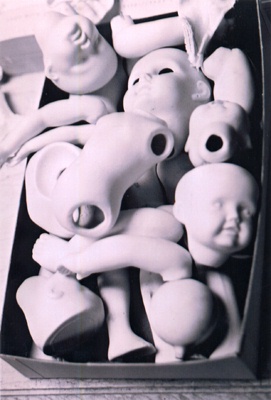
“I couldn’t stop him!” It was Jackie, crouching there in the mud, barefoot and still wearing her pajamas. They were painted brown and red—an awful, sticky red. Surrounding her were the parts of a doll—there, a wooden leg; there, a chubby little hand
“Holy smokes,” said one of the police officers.
“Here now, little girl,” said one of the other officers, crouching low, “just calm down.”
“No! You don’t understand!” Jackie backed away, trying to pick up all the shattered parts of Mr. Jimmy, but there were too many of them, and they tumbled out of her arms. She had destroyed him. She had beaten him to smithereens. “He said he needed my help, but I didn’t know, I didn’t think he would—I didn’t think I would—”
Jackie looked up at them, these men and women with their shining white lights. Behind them, Jackie’s mom and dad came out of the house in their robes and slippers. Jackie’s mom put her hands over her mouth.
“Grab her,” muttered one of the police officers. “She looks nuts.”
“But she’s just a little girl!” Jackie’s mom cried.
The police officers took hold of Jackie’s skinny arms and wrenched her out of the mud. She kicked and screamed, she bit at them. She hit them, and her hands scraped their cheeks, because her palms had bits of glass in them, and splinters of wood.
“But I love him!” Jackie screamed. One of the police officers threw her over his shoulder, and Jackie reached behind him, struggling toward the pieces of Mr. Jimmy. “It was only because I love him! He told me to do it. He told me to!”
One blue eye stared back at her from the muddy ground. One blue eye above a shattered red smile.
The story of Jackie and Mr. Jimmy is similar to that of the chicken and the egg.
Which came first?
Did Mr. Jimmy come to life because Jackie loved him? Or did Jackie love him because he was alive?
Or maybe it was like the real answer to the chicken and the egg question:
What does it matter? The end result is the same: One loses its head, the other gets cracked open.
The Cake Made Out of Teeth
Henry Higginbotham was generally considered to be the worst child in the world, but even then, it’s hard to say if he deserved what happened to him.
Do note the use of the word “generally” rather than “universally,” for Henry’s parents, as is often the case with horrible children, believed their son to be remarkable, precocious, and even darling.
For example, when Henry would not eat his supper of chicken and green beans, instead choosing to sit at the table hurling insults at his parents for a solid quarter of an hour, and then proceeding to throw the green beans at their heads like darts, Mr. and Mrs. Higginbotham praised his stubborn spirit and fixed him a heaping platter of cookies instead.
When Henry was called to the principal’s office for bullying the third-graders—pinning them to the blacktop during recess and pummeling them until he was satisfied; calling them nasty names that would have made even hardened criminals cover their ears—Mr. and Mrs. Higginbotham gave the school board a heap of money in exchange for “putting this punishment business behind us.” They then congratulated Henry all the way home, for inspiring the younger students with his physical prowess.
And when Henry threw an absolute raging fit the day of his 11th birthday, declaring the birthday cake his mother had worked so hard to make “an ugly heap of eyeball pus,” Mr. and Mrs. Higginbotham sent home the partygoers at once (who were only too glad to leave, having been bullied by Henry into attending) and took Henry into town for a new cake.
Of course—and this should not be surprising—not just any bakery would do. Not the bakery in the supermarket, and not the fancy bakery with all the cupcakes in the windows—but the little bakery far on the outskirts of town, in a neighborhood the Higginbothams did not normally frequent . . . ah. Henry pressed his face against the car window and smiled at the sight of the tiny rundown building with the faded lettering: MR. HONEY’S HAPPY DELITES.
Henry began thinking of all the ways he could make fun of the unimpressive shop’s proprietor, and his shriveled black heart leapt with glee.
“What a dump,” said Henry. “We’ll go here.”
“But Henry,” protested Mrs. Higginbotham, “don’t you think it looks a bit shabby?”
Henry whirled on his mother, smiling when she shrank back from him. “What, do you think I’m blind, you idiot? I said we’ll go here and we’ll go here. I know what I want.”
“Of course you do, son,” said Mr. Higginbotham, glaring pointedly at his wife. “You know what’s best.”
Henry marched up to MR. HONEY’S HAPPY DELITES and let himself in, his parents hurrying to catch up. Inside the bakery, Henry stopped short, for the inside of the bakery and the outside of the bakery were, in a word, incongruous. Bright white tile covered the floor, warm lights blinked overhead, and displays of cakes, cupcakes, cookies, and pies sat behind pristine glass windows. Bright posters of laughing children at birthday parties and picnics and bowling alleys covered the walls. Some sort of cheery old-fashioned music came from a radio in the corner.
Henry scoffed, to cover his surprise. “Wow. This place is so . . . cheesy. What is this, 1950?”
At that moment, a man came out from the kitchen through a set of swinging doors, and said, “Hello there. I’m Mr. Honey. How can I help you today?”
Now, Mr. Honey was a man so exceptionally handsome that even Henry felt a bit discombobulated. He had fair skin and fair hair and fair eyes, and a wonderful smile that made Mrs. Higginbotham say to herself, “Well, my heavens,” and blush a bright pink.
Henry saw the blush, and felt furious. His mother was not supposed to think anyone handsome but Henry himself. So he marched up to Mr. Honey and slammed his fist against the cake displays with every screamed word:
“Give us a cake. Now.”
Mr. and Mrs. Higginbotham rushed forward to gush about how delightfully outspokentheir son was—and, perhaps, to more closely inspect Mr. Honey’s handsome smile—but Mr. Honey ignored them. He had eyes only for Henry. You could say, in fact, that they were staring each other down, Henry with a fearsome scowl on his face (his most typical expression) and Mr. Honey with a broad smile.
“It’s for his birthday,” Mrs. Higginbotham explained. “The cake we gave him wasn’t good enough.”
“The cake you gave him,” Mr. Higginbotham added sourly, eager to get back into Henry’s good graces. “I told you we should have gone with a store-bought cake. Didn’t I, Henry?”
“Oh, shut up, both of you.” Henry was in top form. “Do you see what I have to put up with?”
Mr. Honey nodded, his smile a bit smaller now, and his eyes a bit less kind. “Oh, yes. I see quite a lot. If you’ll excuse me for one moment, I think I have just the thing.”
When Mr. Honey returned from the kitchen, he held in his arms an astonishing cake. Not only was it enormous, but it looked just like Henry. Yes, a boy-shaped cake, from head to toe—from Henry’s brown hair to his red hi-top sneakers. His exact sneakers! In fact, the only thing about the cake Henry that was different from the real Henry was that cake Henry was . . . smiling.
Mr. and Mrs. Higginbotham found it unsettling to look at, and stepped away.
Henry, however, was enamored. A cake, an entire cake, that looked just like him! It was, he decided, the perfect tribute. He wouldn’t have to sit and look at stupid balloons or animals or other meaningless icing decorations while he ate. No, he would be able to look at himself, and was there anything in the world he liked to look at more than his own reflection? (There wasn’t.)
“We’ll take it,” he said, looking up at Mr. Honey.
Mr. Honey smiled, but it did not reach his eyes. “Yes. I thought you might.”
*
At first, everything seemed marvelous. As soon as the Higginbothams arrived back at home, Henry commanded his parents to set up a fresh table setting. They were, he told them, to sit there and watch while he ate a piece of cake, surrounded by his piles of presents.
“Maybe,” Henry said, “if you’re good, if I feel like it, I’ll let you have some cake too.”
Mr. Higginbotham smiled gratefully. “Oh, isn’t that generous of you, Henry?”
“So generous,” Mrs. Higginbotham agreed, though she wasn’t sure she actually wanted any of that cake. It was, she thought, too disturbingly lifelike to be trusted.
She wasn’t wrong.
“Where shall I start?” Henry lovingly inspected his cake, admiring the shape of his own arms and legs. “I suppose I’ll start at the bottom and work my way up. Father, cut off the left foot. And hurry. I’m hungry.”
Mr. Higginbotham sliced off cake Henry’s left foot and slid it onto real Henry’s plate, and the latter began to eat, and . . . oh. Oh. It was, without doubt, the best cake Henry had ever eaten. The icing melted on his tongue; the cake was moist and rich. But as Henry put the last bite of foot into his mouth, he noticed something strange; he paused mid-bite. His eyes went wide, and his face went green. He swallowed, and began to scream.
“Something’s eating me! Help me! Help, make it stop!”
For a moment, Mr. and Mrs. Higginbotham watched in stunned silence as their son fell to the floor, writhing and sobbing and clutching his left foot. What they did not yet know was that, though, technically, nothing was eating their son, he certainly felt like it was. All over his left foot, he felt the nibbling of teeth; they tore at his flesh, chomping, swallowing, grinding his foot bones into little bone granules. And Henry knew, instinctively, that the teeth he felt were his own.
“Make it stop!” Henry clawed at his own flesh, drawing bloody red marks across his skin, which, as you can imagine, did nothing to help the pain. “MAKE IT STOP MAKE THEM STOP MOMMY DADDY MAKE IT STOP!”
Now, Henry Higginbotham had not called his parents anything but their first names, scornfully, since the moment he was able to speak. So hearing him scream Mommy and Daddy like that shocked Mr. and Mrs. Higginbotham into action. They did everything they could to help Henry; they bandaged his foot, they forced medicine down his throat between his screams, they took him to the hospital to have him examined. But the bandages, of course, did nothing; and Henry just threw the medicine right back up, in this sour, evil-smelling puddle; and the doctors could find nothing wrong with him.
“He’s having a tantrum,” they said. “Just let him cry it out.” (The doctors were not, as most people in Berryton were not, the biggest fans of Henry Higginbotham.)
Helplessly, Mr. and Mrs. Higginbotham returned home, and watched Henry scream and sob and bang his fists against his foot until he passed out, in a drooling puddle on the floor. His left foot was a quite abused shade of red. Mr. Higginbotham picked Henry up and put him to bed; Mrs. Higginbotham cleaned up in the kitchen. Together, as Henry slept upstairs, they sat at the kitchen table in silence, and stared at the one-footed cake.
*
The next day, Henry limped downstairs in a terrible temper.
“I’m hungry,” he announced, with his usual haughtiness (but he did eye the cake, wrapped up innocently on the countertop, with no small amount of suspicion).
Mrs. Higginbotham offered him a plate of eggs, and though Henry complained about their consistency, he gobbled them up. Perhaps he was eager to get the sugary aftertaste out of his mouth? But no sooner had he swallowed the last bite did it all come back up, in a most unsettling and foul-smelling puddle of steaming black goop.
The Higginbothams looked at the black goop in dismay. Henry blinked. “But I’m hungry,” he said, and Mrs. Higginbotham quickly toasted some bread, while Henry banged on the kitchen table with his knife and fork. But the toast was no good either; and neither was the waffle, the bowl of strawberries, the bowl of cereal. Every bit of food came back up stinking like rotten eggs, and each time, Henry became hungrier, and, worst of all, he began to crave a piece of cake. Yes, his foot still stung with the memory of all those invisible teeth eating him, and yes, he had had nightmares too unspeakable to write about, but he was hungry. And he knew only the cake would satisfy him.
So, Henry made a dive for it, dragging it off the countertop and into his lap. Mr. and Mrs. Higginbotham tried to stop him, but he flung them away with a hiss, and a terrible look in his eyes, and began scooping the right foot of cake Henry into his mouth.
Mr. and Mrs. Higginbotham watched, horrified, as Henry finished eating his right foot and once again began to flail and thrash across the ground, shouting terrible things: “IT’S EATING MY FOOT, I’M EATING MY FOOT, I CAN FEEL THE TEETH, IT HURTS, IT HURTS!” He begged them to make it stop, but, of course, they could do nothing.
Nothing, but take him back to the place where the cake was made.
*
Mr. Honey was waiting for them, standing politely behind the counter of his shop in a fresh white apron.
“Now see here,” Mr. Higginbotham said, slamming the cake down on the countertop. “You’d better explain yourself, sir.”
“This cake is hurting our son,” Mrs. Higginbotham said tearfully. “I don’t understand it, but it is.”
Henry, chomping and slobbering to himself at his father’s side, made a wild-eyed leap for the cake, even though he was still crying.
“MORE CAKE,” he said, clambering up onto the countertop. “No no no no. YES. MORE CAKE. Make it stop, oh it hurts me!”
It was as though Henry was having a conversation with himself. Mr. and Mrs. Higginbotham backed away from him, huddling in the corner by the refrigerated ice cream cakes.
Mr. Honey stood and watched. “It’s eating you alive,” he said, “isn’t it?”
Red-eyed, red-footed Henry looked up at Mr. Honey. “Yes. YES.”
“Good.” Mr. Honey’s eyes flashed. “Horrible children deserve horrible cakes.”
Then Mr. Honey smiled and turned to Henry’s parents, and despite the fact that her son was rolling around on the floor screaming like a demon, Mrs. Higginbotham patted her hair smooth and Mr. Higginbotham puffed up his chest impressively.
“You should take him home,” Mr. Honey said. “There isn’t anything to do now but finish it.”
“Now see here,” Mr. Higginbotham said once more, “I’ll call the police on you, I will. You can’t just—you can’t just poison someone and get away with it.”
Mr. Honey smiled; it was not a nice smile; it could, in fact, be described as bestial. “The only poison in Henry is his own.”
The Higginbothams left quickly after that, Mrs. Higginbotham wondering what she had ever seen in the handsome baker man, and Mr. Higginbotham sustaining a good number of bite marks from the wailing Henry.
Cake Henry stared at everyone, smiling, from the back seat.
*
To this day, the Higginbothams’ neighbors trade gossip about what happened to the Higginbotham family that terrible week in August, when all they could hear from the Higginbotham house was Henry’s unearthly screams.
“Maybe they’re finally teaching him a lesson,” said Mr. Bradhurst, on Monday. “Brat’s needed a good beating for years.”
“Maybe he’s decided he’s not getting enough attention,” suggested Mrs. White, on Tuesday, “so he’s moved on to constant screaming. You can’t ignore screaming.”
“Should someone call the police?” asked Mr. Rockwell, on Wednesday.
No one called the police.
Quite a few of them, they shamefully (but not too shamefully) confessed some time afterward, had hoped something awful was happening to Henry Higginbotham—though none of them could have guessed how awful that something was.
*
At the end of that week, when all that was left of cake Henry was its smiling, red-cheeked head, the Higginbotham family gathered around it on the floor of the kitchen, for Henry could no longer sit up properly.
His entire body was red with teeth marks and brown with bruises where he had punched himself to try to stop the pain. He had spent the week either miserable with hunger and craving cake, or devouring said cake and then feeling it, as it coursed through his body, devouring him. He had, like a wicked game of reverse Hangman, eaten his way through all of cake Henry . . . except for the head.
“This is it,” Mr. Higginbotham said, exhausted. “Just one last helping, Henry, and this will all go away.”
Mrs. Higginbotham was so tired, her head so filled with Henry’s screams, that she felt a bit mad. “Just . . . eat it, Henry. And hurry.”
Henry, on the floor, dragged himself closer to the cake and looked at his parents with bleary, wild eyes. “Help me,” he said, in a voice not entirely his own, and not entirely Mr. Honey’s, but an unnatural blend of the two. It was deep and horrible and eager. “Help me eat it.”
Mr. and Mrs. Higginbotham shared an uncertain look.
“HELP ME EAT IT. THIS IS YOUR FAULT. YOU MADE ME. HELP ME EAT IT. IDIOTS. STUPID. STUPID IDIOTS STUPID IDIOTS.”
They did, fumbling for forks—as if forks mattered at such a time!—and when Henry—just Henry’s voice, this time—screamed, “No! Wait! DON’T!” it was too late, for Mr. and Mrs. Higginbotham had already taken their first bites.
And Henry collapsed, mouth full of cake, screaming the loudest he had yet screamed. For now it was not only his teeth chomping through his skull and across his face, but also his parents’ teeth, and there was something infinitely worse about that.
When it was finished, however, when the last bites had been swallowed and the cake platter licked ravenously clean by Mr. and Mrs. Higginbotham (who had, in the eating of cake Henry’s head, discovered how good this cake was, how irresistibly sweet), Henry lay stone still and cold on the floor, white as a sheet, his eyes open in shock.
And for a few minutes, Mr. and Mrs. Higginbotham thought he was dead.
(But of course, he wasn’t dead. What a wasted effort that would have been.)
Mr. and Mrs. Higginbotham realized, as they stared at their possibly-dead son, that they weren’t as beat up about it as they ought to have been, and this thought so completely disturbed them, that when Henry blinked awake at last, his parents vowed to make things different from that moment on. How they would make things different, they weren’t sure. (But life, they would soon find out, would be much easier for them now that Henry had apparently lost all will to speak and instead devoted himself to peaceful, solitary tasks like bird-watching and organizing the spice cabinet.)
Mr. Higginbotham, however, did know one thing he would do, now that the frightening week had passed and he could think clearly once more. He picked up the phone and called the police, describing the odd bakery on the outskirts of town, and how he suspected the proprietor, a “Mr. Honey,” had sold his family a poisoned cake.
“See that he’s put out of business, will you?” said Mr. Higginbotham authoritatively. “No man should be able to get away with something like that.”
“Of course, Mr. Higginbotham, we’ll start our investigation right away,” said Sergeant Moseley, who had been taking notes at the police station.
Both men hung up, Mr. Higginbotham feeling quite good about how effectively he could get things done. Sergeant Moseley, who didn’t care for the Higginbothams and their horrid son, begrudgingly started an investigation anyway, because the Higginbothams had recently helped financed the construction of the new city hall.
So, as Mr. and Mrs. Higginbotham carried their pale, speechless son to bed and tucked him in as they had always longed to do (and which he had never permitted them to do), Sergeant Moseley and his deputy drove to the outskirts of town and found the bakery, just as Mr. Higginbotham had described it . . . at least, on the outside.
Inside, however, the counter displays were crawling with moldy cakes, the kitchen was buzzing with flies, and the refrigerators held congealed, rotten pools of melted ice cream.
“There’s no one here!” said the deputy, pushing back his cap. “And it stinks to high heaven.”
“That Higginbotham’s an idiot,” muttered Sergeant Moseley, who had just found something odd on the floor behind the counter.“What is this, some kind of sick joke?
He picked it up and frowned at it—an old stained apron, obviously not worn for years. On the apron’s nametag, swirling blue letters read MR. HONEY. The fabric smelled rotten, like cake gone bad, and no matter how many times Sergeant Moseley washed his hands after that, he could never quite get out the stench.
~*~
Hello, Good Day, and Welcome
Imagine, if you will, a door in a wall.
Go on. Close your eyes. You can trust us.
Now, imagine that the wall is made of crumbling brick. It is part of a building set low on the side of a seldom traveled road, and that road lies at the edge of a wood you cannot enter unless you know the way. The door is weathered. Its peeling paint bears the prints of many a desperate hand, a dangerous hand, an innocent hand, and all of them curious. The knob is brass, worn dark; the threshold smells of spices, of candlelight and old things. The latch will open for no key. It will, however, open for the curious at heart.
Are you one of those curious souls?
If so, welcome. You have found the Cabinet of Curiosities.
Inside the Cabinet, you will find many rooms — tiny ones and cavernous ones, rooms lined with shelves of trinkets and rooms that contain only what you bring inside them (so be mindful of what you carry). You will find many treasures in these rooms — relics and remnants, secrets and stories. Some of them may be beautiful, and some of them may be ugly, but rest assured, you curious visitors, they will all be strange — and sometimes even frightening. But you are brave, aren’t you?
Take heart: Four Curators are here to guide you, to help you find the particular bit of oddity you seek, and to share with you the stories of our curiosities. How did we obtain this one-eyed doll, or that dainty bird skeleton? What fills those jars labeled in an undecipherable language? Who once wore this jewelry that whispers of murder, what child sat at this shivering desk, what pirate used this glass eye — and why, when you look into it, do you see glimpses of your past?
Join us, every Wednesday, when one of we Curators will share with you a story sure to entertain and entrance. And, as we are Curators — and therefore more organized than your average eccentric — do note that each month of stories will fall under a different theme. This month, the theme is cake, to celebrate the beginning of our adventures together.
Come. Close your eyes and step through the tired old door into our world of strangeness and dark delights.
We, your Curators — Stefan Bachmann, Katherine Catmull, Claire Legrand, and Emma Trevayne — are so glad to see you.
Welcome to the Cabinet of Curiosities.